The Dynasty Fitness
Leg Extension/Prone Leg Curl
Leg Extension/Prone Leg Curl
Couldn't load pickup availability
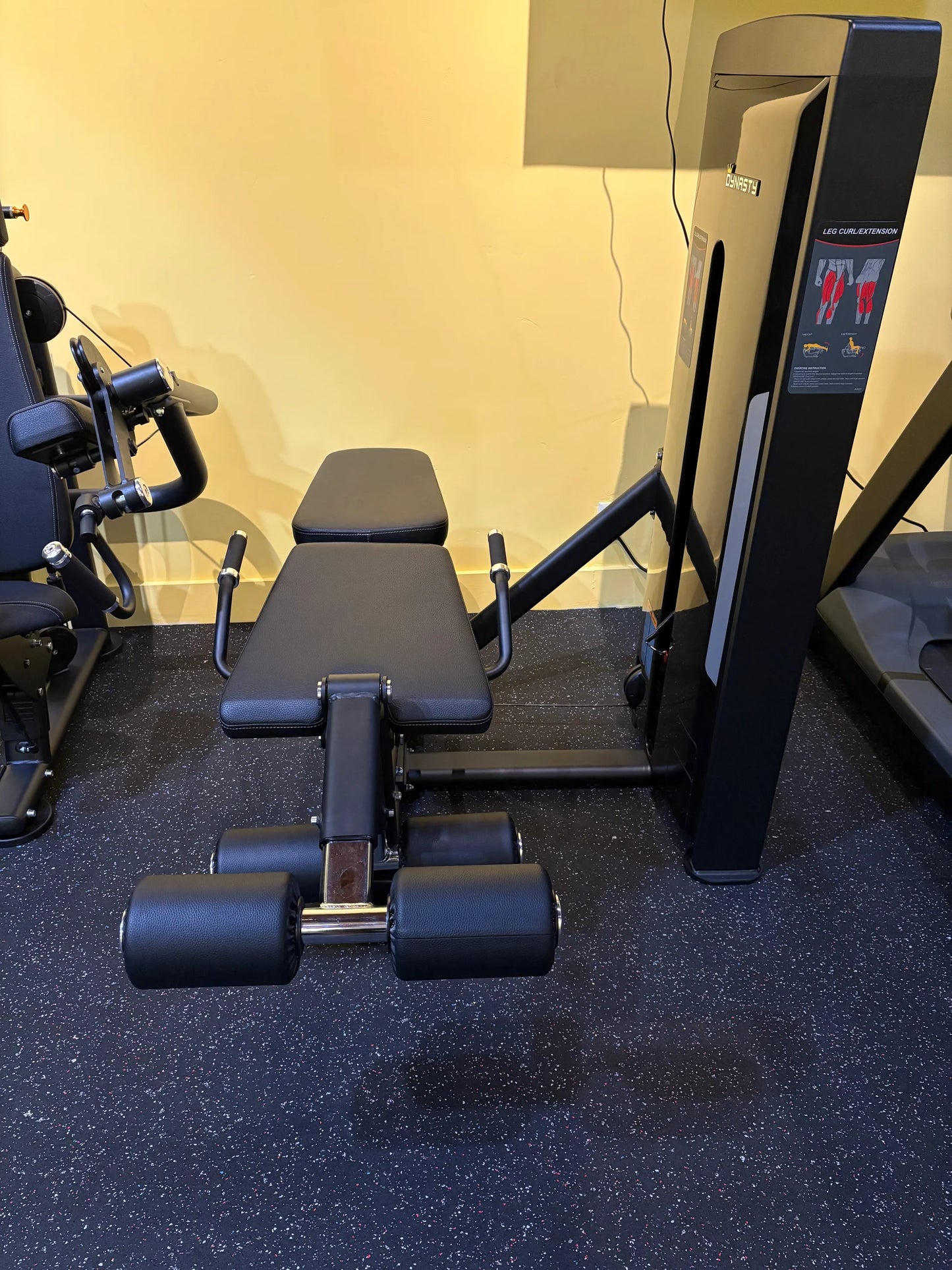
The Dynasty Fitness DSA031 Leg Extension Prone Leg Curl is a dual-function selectorized machine that trains the quadriceps through seated leg extension and the hamstrings through prone leg curl from the same pivot frame and weight stack. A pivot frame assembly running on two 6005-2Z bearings with two independent pop pins manages the transition between modes, while dual roller sets and two separate handle configurations orient the body correctly for each exercise without requiring any cable or pulley adjustment. Built from Q235A cold-rolled steel with a 200 lb selectorized weight stack and a gas spring back pad for comfortable prone positioning, the DSA031 covers both primary knee joint isolation movements in a single 45.4" × 62.1" footprint. It is built for commercial facilities, private training studios, and home gyms where complete quad and hamstring isolation training is a program requirement without the floor space cost of two separate dedicated machines.
- Dual-function selectorized machine covering seated leg extension for quadriceps and prone leg curl for hamstrings from the same pivot frame and 200 lb weight stack
- Two independent pop pins and a precision pivot frame assembly on 6005-2Z bearings switch between exercise modes without cable adjustment, attachment changes, or pulley reconfiguration
- Dedicated front handles for leg extension and separate rear handles for prone leg curl orient the body correctly for each movement so grip position actively supports the exercise rather than being neutral
- Gas spring back pad holds the prone position comfortably during hamstring curl sets so the lumbar spine stays supported without the user having to brace against the pad throughout the set
Exercise and muscles targeted
| Exercise | Muscles Targeted |
|---|---|
| Seated Leg Extension | Quadriceps (Rectus Femoris, Vastus Lateralis, Vastus Medialis, Vastus Intermedius, all four heads, primary), Tibialis Anterior (stabiliser at ankle during full extension) |
| Leg Extension — Terminal Knee Extension (partial ROM) | Vastus Medialis Oblique (VMO) (primary in the last 30 degrees of extension), Rectus Femoris (secondary), commonly used in knee rehabilitation and VMO-focused programming |
| Leg Extension — Isometric Hold (peak) | Quadriceps (sustained isometric contraction at full knee extension), Tibialis Anterior (sustained stabiliser), Rectus Femoris (isometric at hip and knee simultaneously) |
| Prone Leg Curl | Biceps Femoris (long and short heads, primary), Semimembranosus (primary), Semitendinosus (primary), Gastrocnemius (secondary, assists knee flexion), Popliteus (stabiliser at knee initiation) |
| Prone Leg Curl — Toes Plantarflexed | Biceps Femoris (primary), Semimembranosus, Semitendinosus, Gastrocnemius (increased contribution when foot is pointed, secondary to primary depending on load) |
| Prone Leg Curl — Toes Dorsiflexed | Biceps Femoris (primary), Semimembranosus and Semitendinosus (primary), Gastrocnemius (reduced — dorsiflexed ankle shortens gastrocnemius and limits its contribution), greater isolated hamstring focus |
| Prone Leg Curl — Isometric Hold (peak flexion) | Hamstrings (all three heads, sustained isometric at full knee flexion), Gastrocnemius (isometric), Popliteus (knee joint stabiliser) |
The leg extension and prone leg curl cover the two opposing movement functions of the knee joint in isolation: extension driven by the quadriceps, and flexion driven by the hamstrings. Neither movement can be adequately replicated by compound exercises alone, as squats and deadlifts always load these muscles in combination with the hip and require significant stabiliser involvement. The DSA031 isolates each muscle group purely through the knee joint with no hip involvement required, which makes it the appropriate tool for direct quad and hamstring hypertrophy work, knee rehabilitation programming, and addressing strength imbalances between the two muscle groups.
Who this machine was built for
Serious Home Gym Builders
Dedicated leg extension and prone leg curl machines are two of the most commonly omitted pieces of equipment in home gyms because they appear to serve narrow purposes at a high space cost. The DSA031 resolves this by putting both in a 45.4" × 62.1" footprint from a single weight stack. For a home gym that already covers squatting and hip hinge patterns with compound equipment, the DSA031 adds the quad and hamstring isolation layer that compound movements alone cannot deliver.
Bodybuilders and Physique Athletes
Quad sweep, VMO fullness, and hamstring separation are the specific aesthetic outcomes that leg extensions and prone leg curls develop, and they require dedicated isolation volume that barbell squats and Romanian deadlifts cannot produce in the same training effect. The DSA031 covers both from the same station, which allows a complete quad and hamstring isolation circuit without moving to a second machine. The foot angle variation on the prone curl also allows the gastrocnemius contribution to be increased or reduced depending on whether the session priority is pure hamstring isolation or broader posterior chain work.
Commercial Gym Owners and Operators
Leg extension and leg curl machines are two of the highest-traffic stations in any commercial facility. A dual-function machine that covers both from one unit reduces the footprint required for complete lower body isolation coverage and keeps members cycling through the station faster when one mode is occupied. The DSA031's 503 lb total weight keeps it grounded under continuous bilateral and unilateral use, and the fully enclosed shroud system protects the cable and pulley components from the accumulation that high-use stations experience in commercial environments.
Physical Therapists and Sports Medicine Practitioners
The leg extension in its terminal range (the final 30 degrees of knee extension) is a standard VMO activation exercise in knee rehabilitation protocols following patellofemoral conditions and ACL recovery, depending on the clinical protocol in use. The prone leg curl is similarly used for progressive hamstring loading in rehabilitation contexts where hip-loaded hamstring exercises cannot yet be tolerated. The DSA031's selectorized precision allows exact load prescription per session, and the pop pin mode switch allows the same machine to deliver both exercises within a single rehabilitation session. Exercise selection and loading must always follow the specific clinical programme and practitioner guidance for each patient.
University and College Athletic Departments
Quad-to-hamstring strength ratio is a standard screening metric in athletic injury prevention programmes. Athletes with weaker hamstrings relative to their quadriceps carry a higher risk profile for knee and hamstring injuries during deceleration and cutting movements. The DSA031 allows S&C coaches to address both sides of the ratio from a single machine, testing and training each direction independently and tracking the balance across a training cycle. The dual-function format also improves session efficiency when multiple athletes are rotating through a lower body isolation circuit.
Private Personal Training Studios
The mode switch between leg extension and prone leg curl on the DSA031 requires no cable or pulley adjustment, only a change in body position and the two pop pin adjustments for the pivot frame. A trainer can move a client from quad extension to hamstring curl in under a minute without losing session momentum. The gas spring back pad holds the prone position without requiring the client to manually brace against it, which removes a common comfort barrier for clients who find prone machine positions uncomfortable on less well-designed alternatives.
Owners Manual
Share